
Fiber Drop Clamp Selection: Flat, Round, and ADSS Cable
A fiber drop clamp holds the service cable at the pole, strand, or building without crushing the jacket. Selection starts with cable shape and diameter, then moves to load, mounting surface, and the hardware it connects to. This guide compares flat, round, and ADSS drop clamps and the checks that prevent slip and cable damage.
Drop clamps look alike in a bin. The differences appear when the clamp meets the cable: a flat profile sits in a round groove, a stainless body closes on a soft jacket, or a clamp sized for one cable slips on another. Sorting those details before the install is faster than recovering a drop that has already been tensioned.
For the surrounding components and the installation order, see the aerial drop hardware overview.
Start with the cable profile
The cable decides the clamp. A flat drop cable needs a body that supports the wide faces without pinching the edges. A round drop cable needs a groove that matches the jacket diameter and grips evenly around the circumference. ADSS cable needs a clamp that controls compression and bend radius without relying on a metallic messenger.
Read the cable datasheet before the clamp datasheet. Note the jacket material, the outside dimensions, the stiffness, and the minimum bend radius. A clamp that fits the nominal size but not the actual jacket can still slip, and a clamp that grips hard enough to hold may leave a mark that becomes a crack later.
Flat, round, and ADSS profiles
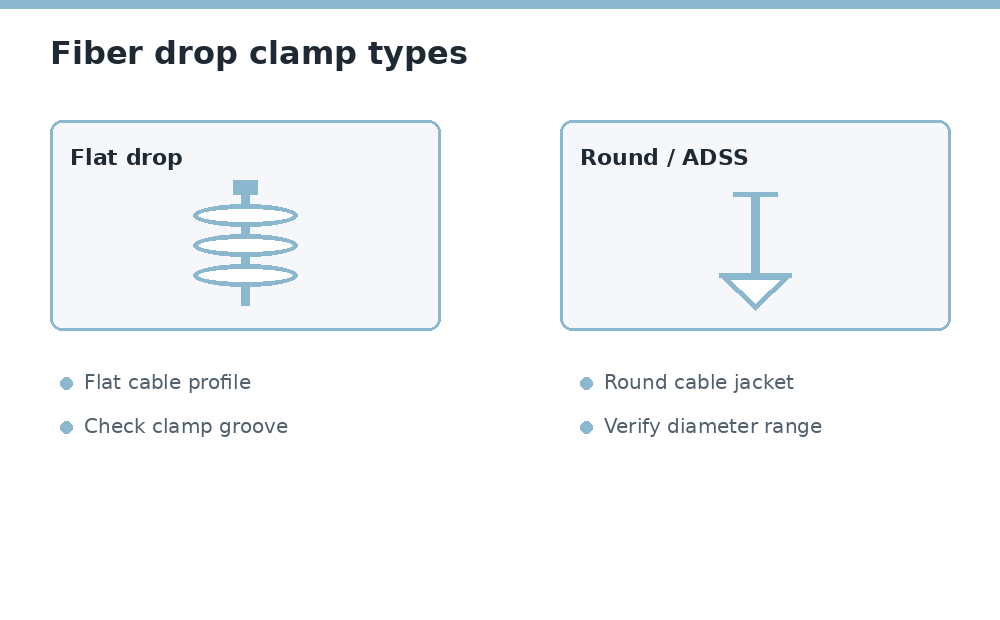
The three common profiles solve different mechanical problems. Flat drop clamps support a cable with two broad faces. Round and ADSS clamps wrap a cylindrical jacket. The groove shape, contact area, and closing method change with the profile.
| Cable profile | Clamp feature to check | Common failure |
|---|---|---|
| Flat drop | Groove width and edge support | Jacket rolled or pinched at the edge |
| Round drop | Diameter range and contact area | Clamp closes on the high spots and slips |
| ADSS | Compression control and bend radius | Jacket deformation or fiber strain |
The table is a starting point, not a substitute for the datasheet. A clamp family may cover more than one profile with different inserts or bodies. Confirm the exact configuration with the manufacturer before mixing parts.
Load path and mounting surface
A drop clamp has to transfer load into something solid. At the pole, that may be a strand, a bracket, or a band. At the building, it may be a wall, a fascia, or a mast. The clamp body and the fastener are a pair; a clamp rated for the cable but fastened to a soft surface will move under wind or ice.
Check the direction of pull. A clamp loaded along its axis behaves differently from one loaded sideways. On a corner or a change in elevation, the resultant pull may not match the mounting plane. Use the attachment hardware the clamp was designed for, and confirm the fastener material matches the outdoor exposure.
Installation checks that prevent slip
Installation decides whether the clamp holds. A clean jacket, correct seating, and even closure matter more than a final extra turn on the fastener.
- Wipe the cable jacket where the clamp will sit. Grit or cable gel reduces grip.
- Seat the cable fully in the groove before closing the clamp body.
- Close the clamp evenly. Tightening one side first can cock the body and concentrate load.
- Confirm the clamp is positioned where the cable will not rub on the strand, bracket, or wall.
- Check the bend radius on both sides of the clamp, especially at the house entry.
- Record the clamp model and cable type so the next technician can match replacements.
Do not use a clamp to pull slack out of a run. The clamp holds position; the tensioning method sets the load. Pulling through a clamp can damage the jacket and leave the clamp at the wrong point on the span.
Inspection and common failure modes
Inspect drop clamps after the first tensioning and again on routine visits. Look for jacket deformation, clamp movement, corrosion at the fastener, and cable contact with sharp edges. A clamp that has moved usually leaves a clean band on the jacket; that mark tells you where it started and how far it traveled.
Replace a clamp that has deformed the jacket, even if it still holds. The damage can progress under wind and thermal cycling. If a clamp keeps slipping on a cable that matches its stated range, check the installation and the cable surface before assuming the clamp is undersized.
Frequently asked questions
Can one drop clamp fit flat and round cable?
Some clamp families use different inserts or bodies for different profiles. The same body usually cannot support both shapes well. Confirm the exact configuration and cable range with the manufacturer.
Should I use stainless steel clamps near the coast?
Stainless steel is common for outdoor drop hardware because it resists corrosion. The grade and the fastener material still matter. Confirm the assembly for the exposure and avoid mixing incompatible metals without a corrosion plan.
How tight should a fiber drop clamp be?
Tight enough to hold the cable without deforming the jacket. Use the manufacturer’s installation instruction and inspect the jacket after closure. A torque value from another clamp model does not transfer.
What causes a drop clamp to slip?
Wrong diameter range, a dirty or wet jacket, uneven closure, or a clamp loaded beyond its intended direction. Check the cable and installation before changing to a larger clamp.
Matching a clamp to your drop cable?
Send the cable profile, jacket dimensions, mounting surface, and expected load direction. The Quan Pham team can confirm the clamp body and hardware for the run.
Explore the full Aerial Drop Hardware category or browse the Hardware Guides hub.