



Guy Attachment Hardware: Clamps, Hooks, and Eye Nuts
Guy attachment hardware transfers guy tension from the strand into the pole and down the anchor rod. The assembly has to match the strand size, the rod thread, and the attachment angle. This guide explains the common parts, how they fit together, and the checks that keep a guy line secure.
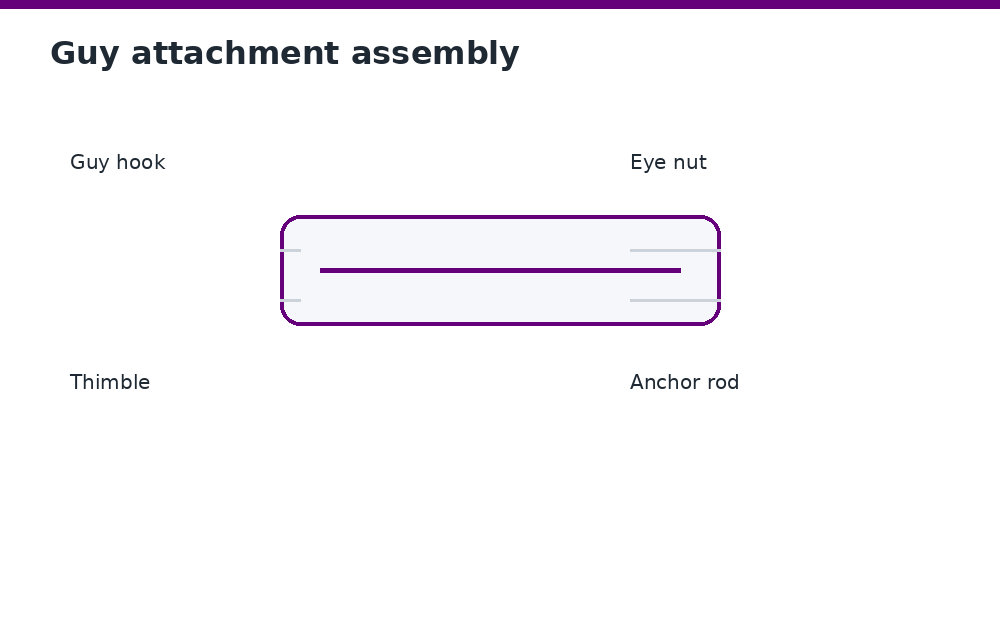
A guy line works only when every part in the chain agrees with the next. The strand, thimble, clamp, guy hook, eye nut, and anchor rod form a load path with several interfaces. A mismatch at any one of them can reduce strength, loosen under load, or make the assembly impossible to tension correctly.
The guy load path
Guy tension starts at the strand and passes through the termination at the pole. The termination connects to a guy hook or bracket, which transfers load into the pole through bolts or a band. At the anchor end, the strand connects to an eye nut or guy adaptor on the anchor rod, and the rod carries the load into the earth anchor.
Each interface has a direction. A guy hook is designed for a particular line angle and pull direction. An eye nut presents a ring for a thimble or clevis. A thimble protects the strand at the bend. When the angle changes, the load on the attachment changes too, so the hardware has to suit the installed geometry rather than the drawing alone.
Guy hooks and pole attachments
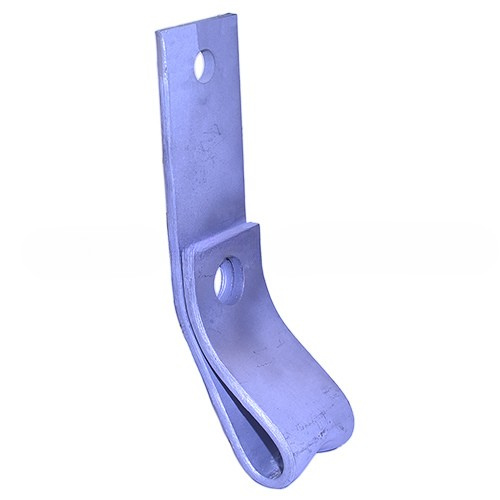
Guy hooks come in several lengths and mounting styles. Short hooks place the strand close to the pole. Long hooks move the connection away from the pole surface, which helps where the strand would otherwise rub against the pole or another attachment. Two-bolt attachments spread load over a longer section of the pole than a single-bolt hook.
Check the hook's strand seat and the bolt pattern against the pole. The hook should pull against the pole squarely, with the bolt heads bearing on flat surfaces. On a round pole, a curved washer or a shaped bracket helps distribute the clamping load. Confirm the bolt diameter and length against the pole diameter and the hardware stack.
Eye nuts and rod connections
An eye nut threads onto the anchor rod and provides the connection point at the anchor end. The thread must match the rod diameter and pitch, and the eye opening must accept the thimble or fitting used with the strand. Thread engagement matters: the nut should run fully onto the rod without crossing damaged threads or stopping short.
Some assemblies use a guy adaptor instead of an eye nut. The adaptor may present a clevis, a slot, or a shaped seat for the strand. Match the adaptor to the rod and to the termination method. Where a coupling nut joins two rod sections, confirm that the coupling and both rod ends share the same thread and that the joint is fully engaged.
Thimbles, clamps, and strand termination
The thimble sits inside the eye of the strand and holds the bend radius. It protects both the strand and the attachment from wear and sharp contact. A thimble that is too small for the strand forces a tight bend; one that is too large may not seat in the eye or hook.
Strand clamps, sometimes called guy clamps, form the termination by gripping the strand against itself. The clamp must match the strand diameter and material. Install the number of clamps the manufacturer specifies, with the correct spacing and the saddle on the load-bearing side. Tighten evenly and inspect for strand slip after tensioning.
- Thimble size matches the strand and the eye or hook opening.
- Clamp groove matches the strand diameter and material.
- Clamp count and spacing follow the manufacturer's instruction.
- Saddles bear on the load-bearing strand.
- Cut strand ends are dressed and not left to fray.
Fit and alignment
Assemble the parts dry before installation where possible. Run the eye nut onto the rod, seat the thimble, and check that the hook and eye line up with the intended strand direction. A twisted assembly puts bending load on parts designed for tension.
Check the guy angle against the attachment's intended working range. A hook loaded outside its design angle may bend or pull out. If the pole or anchor location forces an unusual angle, raise it with the manufacturer rather than forcing the hardware to fit.
Inspection
Inspect guy attachments for bent hooks, worn eyes, missing thimbles, slipped strand clamps, and corrosion at threaded joints. Check that the eye nut is fully engaged and that the rod is not bent. A guy that has lost tension may show a slack strand, a shifted anchor, or a pole that leans more than before.
Record the strand size, attachment type, and rod thread during installation. That record makes later inspection faster and helps when a replacement part is needed. For the surrounding hardware families, see Poleline Hardware: The Complete Buyer's Guide. Pole band sizing, which often supports the guy attachment, is covered in Pole Band Sizing and Installation: A Practical Guide.
Frequently asked questions
Does the eye nut have to match the anchor rod thread exactly?
Yes. Diameter and thread pitch must match, and the nut should engage the full threaded length without binding. A nut that starts but does not seat can carry far less load than the assembly is designed for.
Can I use a guy hook without a thimble?
A thimble protects the strand at the bend and is normally required for a proper termination. Without one, the strand bears directly on the hook or eye and can wear or distort. Follow the assembly specification.
How many strand clamps should a guy termination use?
The number depends on strand size, clamp type, and the manufacturer's instructions. Do not guess. Use the specified count and spacing, and inspect for slip after the guy is tensioned.
What should I check when a guy line loses tension?
Check the anchor, rod, eye nut, thimble, clamps, and hook in that order. A slack strand can come from anchor movement, thread slip, strand slip at the clamps, or a bent attachment. Fix the cause before re-tensioning.
Need help matching guy attachment parts?
Send the strand size, anchor rod thread, pole mounting pattern, and guy angle. The Quan Pham team can confirm the hook, eye nut, and rod combination and quote the assembly.
Explore the full Poleline Hardware category or browse the Hardware Guides hub.


