
Helical vs. Expanding Earth Anchors: Which Type Fits Your Project?
When you compare a helical anchor vs expanding anchor, the decision comes down to how the ground accepts load. Helical anchors screw into soil and develop capacity through helix bearing. Expanding anchors lock a wedge or plate into rock or confined ground. Soil, access, and the installation equipment decide which mechanism you can use.
Both anchor families resist pullout, and both connect to a rod and guy attachment. The difference sits underground: one mobilizes soil around steel plates, the other locks against a borehole or a confined material. That difference drives the site investigation, the installation crew, and the verification step. For the wider family overview, see Earth Anchors Explained: Types, Applications, and How to Choose.
How each anchor holds
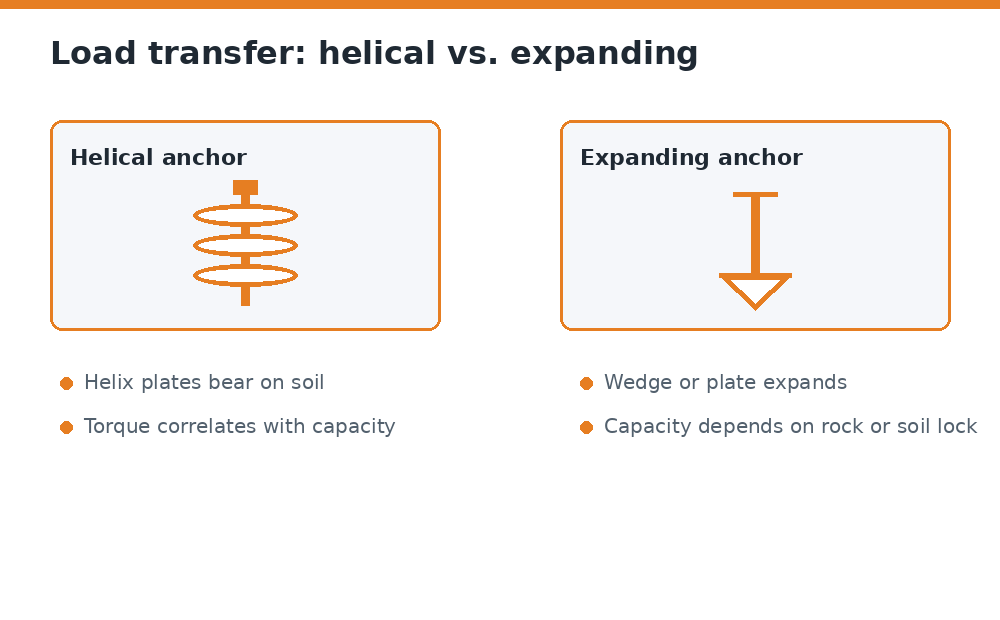
A helical anchor is turned into the ground with a torque motor. The helix plates bear on soil along the shaft, and the rod carries the load upward. An expanding anchor is placed in a hole or opening, then a wedge, plate, or key is forced outward to grip the surrounding material. The load path is short and mechanical.
| Characteristic | Helical anchor | Expanding anchor |
|---|---|---|
| Bearing element | Helix plates bear on soil | Wedge or plate expands |
| Load transfer | Through the rod and hub | Through the expanded element and rod |
| Capacity indicator | Torque correlates with capacity | Capacity depends on rock or soil lock |
| Typical ground | Soft to stiff soil, weathered rock | Rock, hard material, confined sites |
| Field check | Installation torque and depth | Setting tension, expansion, and position |
Where helical anchors fit
Helical anchors suit sites where a crew can turn a rod into the ground and where the soil at embedment depth can provide bearing. Soft clay, loose fill, and layered soil are common candidates, provided the helix can reach a stratum with enough strength. Dense sand and weathered rock may require more drive effort or a different helix configuration.
Torque correlates with capacity in many soil conditions, which makes the torque reading useful during installation. Treat it as an indicator rather than a direct measurement. The correlation depends on soil type, helix geometry, and the equipment used. On critical structures, the engineer should define the torque target and any load verification requirement before the crew starts.
Multi-helix anchors add bearing area at depth and can improve performance in weak soil. They also change the drive effort and the rod demand. A larger anchor does not automatically fit an existing rod or drive tool, so check the assembly as a system and confirm the drive equipment before selecting a multi-helix design.
Where expanding anchors fit
Expanding anchors work best where the surrounding material can resist an outward wedge or plate. Rock is the obvious case. A drilled hole gives the anchor a seat, and the expansion mechanism grips the rock or a stable socket. Confined sites and locations where torque equipment cannot operate may also favor an expanding design.
Capacity depends on rock or soil lock. The material has to hold the expanded element without fracturing, and the hole has to match the anchor. A poor hole, a loose socket, or an expansion that never fully sets will show up as movement under load. Because the working part is buried, verification often relies on the setting procedure and a tension check rather than a torque reading.
Site and load checks before you choose
Start with the ground at the intended embedment depth. A surface inspection is not enough. The anchor has to reach material that can carry the load, and the profile may change with depth. Groundwater, fill, voids, and previous excavation all affect the choice.
- Confirm the soil or rock type at the anchor tip rather than at the surface alone.
- Confirm the required holding capacity and the safety factor with the engineer.
- Check for buried services, obstructions, and nearby foundations.
- Confirm the load direction and whether the guy line will remain in tension.
- Check access for the drill, torque motor, or drive tool.
- Match the rod diameter, thread, and coating to the anchor and attachment.
- Plan how capacity will be verified and recorded.
Installation and hardware differences
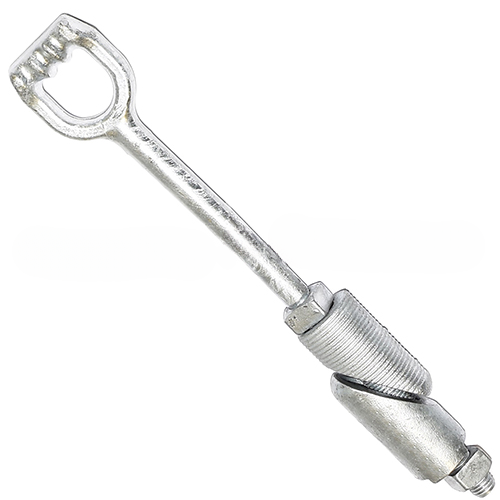
Helical installation needs a torque motor or drive head, a reaction point, and a rod that can transmit the drive torque. The crew watches torque, depth, and rod alignment. An expanding anchor needs a hole of the right size, a setting tool, and a way to confirm expansion. The rod still has to align with the guy line, and the exposed thread has to accept the eye nut or adaptor.
Do not assume the same rod serves both anchors. Hub geometry, thread, and load path differ. A rod that threads onto a helical hub may not connect to an expanding anchor, and a drive tool that fits one hub may damage the other. Confirm the full stack before mobilization. If the assembly includes an extension or adaptor, check that it is rated for the same system and that the threads engage fully.
Selection checklist
Use the anchor that matches the ground and the installation method you can actually execute. A helical anchor specified without torque equipment, or an expanding anchor specified without a suitable hole, will cost more than the original price difference.
- Geotechnical information for the anchor zone.
- Required capacity, safety factor, and verification method.
- Anchor, rod, and attachment confirmed as one assembly.
- Installation tool and access confirmed.
- Corrosion strategy confirmed for buried and exposed parts.
- Installed depth, torque or setting record, and location documented.
Frequently asked questions
Can an expanding anchor be used in soil?
Some expanding designs can work in compact soil, but the mechanism depends on a material that will lock the wedge or plate. Loose or soft soil may not provide that resistance. Confirm the anchor’s intended ground conditions with the manufacturer and the engineer.
Does installation torque equal holding capacity?
No. Torque correlates with capacity in some soil conditions, but it measures installation resistance. Soil type, helix geometry, and depth all affect the relationship. Use the engineer’s verification method for critical work.
Which anchor is better in rock?
An expanding rock anchor is usually the better starting point because it locks mechanically against the rock. A helical anchor may still be used in weathered rock or soil over rock if the helix can penetrate and develop torque. The rock condition at the tip decides.
Can I change the anchor type after the hole is drilled?
Only if the replacement anchor matches the hole, rod, and attachment. Hole diameter and setting method differ between anchor families. A field change should go through the engineer and the supplier before installation.
Need help matching an anchor to your project?
Send the required capacity, soil conditions, rod thread, and installation method. The Quan Pham team can confirm the anchor, rod, and attachment combination and quote the assembly.
Explore the full Earth Anchors category or browse the Hardware Guides hub.