



Bolt Grades Explained: Grade 2, 5, 8, and Metric Classes
Bolt grades identify the strength and material family of a fastener, and the head marking is how you confirm it in the field. Bolt grade tells you the strength and material family. This guide explains Grade 2, 5, 8, and metric classes, and how to read head markings.
A grade is a promise about the steel and the heat treatment, not a promise that the bolt fits the joint. Diameter, thread, length, nut grade, and coating still have to match the connection. The fastener families in Fasteners for Poleline and Utility Hardware: A Buyer's Guide are a useful starting point; this article goes deeper on the grade question.
What bolt grade means
Bolt grade is a shorthand for the bolt's strength and material family. It tells a buyer what the fastener is made to do, and it gives the crew a way to check what arrived. Grade is not a warranty of fit, corrosion resistance, or service life.
Two marking systems dominate utility work: SAE grades for inch-series fasteners and property classes for metric fasteners. They use different labels and different test methods. A Grade 8 bolt and a Class 8.8 bolt are both high-strength parts, but they are not interchangeable without checking thread and dimensions.
SAE grades in utility work
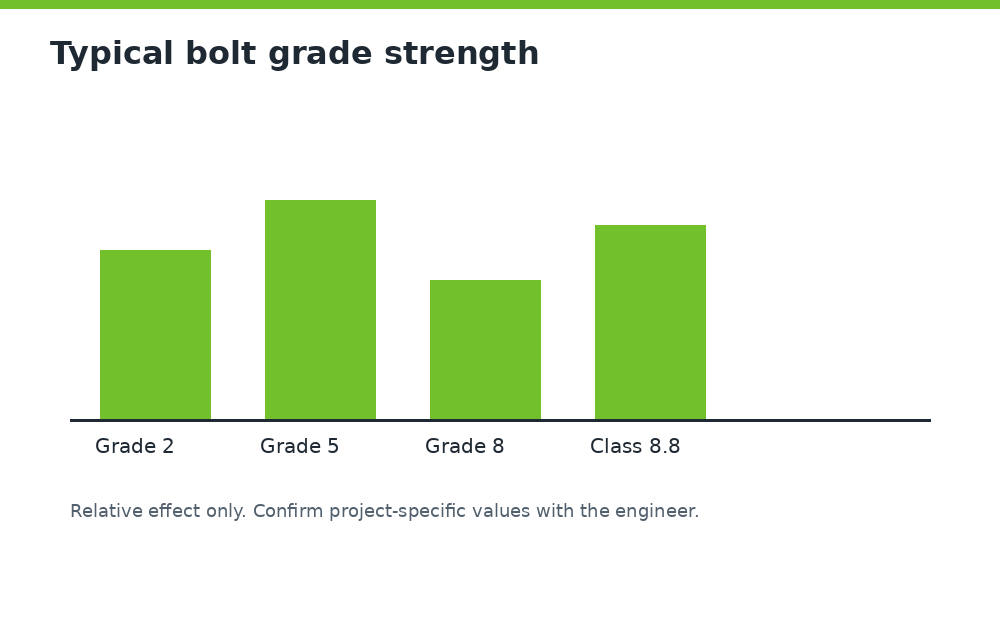
SAE grades are the common language for inch-series bolts on North American utility hardware. The grade usually appears on the bolt head, along with the manufacturer's mark. The exact strength depends on diameter, thread, and the current standard, so confirm the values on the datasheet rather than relying on the grade name alone.
| Grade | Typical character | Where it shows up | Buyer note |
|---|---|---|---|
| Grade 2 | Low or medium carbon, general duty | Light brackets, noncritical clamps | Confirm coating and nut grade; easy to over-tighten |
| Grade 5 | Medium carbon, quenched and tempered | Crossarm braces, pole attachments | Common utility grade; match nut and washer |
| Grade 8 | Alloy steel, higher strength | Heavily loaded connections | Do not substitute for Grade 5 without review; check washer hardness |
Metric property classes
Metric bolts use property classes such as 8.8, 10.9, and 12.9. The number before the decimal relates to tensile strength and the number after to the yield strength ratio. Class 8.8 is a common high-strength class in machinery and imported hardware. Do not read the class as a direct equivalent of an SAE grade; check the actual property values and the thread.
Mixing inch and metric hardware on the same assembly is a fit problem waiting to happen. Threads may look close and still bind. Keep the two systems separated in stores, and label bins clearly so a metric nut does not end up on an inch bolt.
Head markings and paperwork
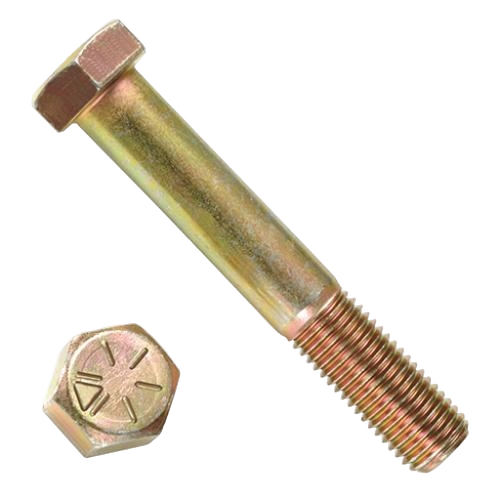
Head markings identify the manufacturer and the grade. A bolt with no marking may be a low-grade part, a special order, or a part that has been refinished. Treat an unfamiliar marking as unknown until the supplier confirms it.
Package labels should show grade, size, thread, length, and coating. Keep the label with the lot when parts are transferred into job bins. On critical work, connect the lot to the inspection or test records.
- Match the head marking to the purchase order before installation.
- Check that nuts carry a compatible grade marking.
- Confirm coating on every part: bolt, nut, and washer.
- Keep test reports or certificates on file when the project requires them.
Matching grade to the joint
Higher grade is not automatically better. A very hard bolt can be the wrong choice for a soft washer or a brittle connection. It can also encourage over-tightening with a long wrench. Match the grade to the load and to the parts around it, and use the installation method the engineer specifies.
Corrosion also enters the decision. A high-strength plated bolt in a wet, salty location may lose section before it reaches its design life. Stainless, galvanized, or a protected assembly may be the better choice even when the applied load is modest. Coating selection is a separate specification decision with its own fit checks.
Frequently asked questions
Is a Grade 8 bolt always stronger than a Grade 5 bolt?
Grade 8 is the higher-strength SAE family, but the comparison depends on diameter and thread. A small Grade 8 bolt can be weaker than a larger Grade 5 bolt. Match the whole connection rather than the grade label alone.
Can I use a Grade 5 nut on a Grade 8 bolt?
Use a nut rated for the bolt and the connection. A lower-grade nut can strip or deform before the bolt reaches its intended clamp load. Confirm the nut marking and the engineer's requirement.
What does 8.8 mean on a metric bolt?
It is a property class, not a torque value. The class describes the bolt's strength family. Confirm exact mechanical properties on the current datasheet and match the nut class to the bolt.
Why do head markings matter in receiving?
They are the fastest field check that the part matches the order. Missing or unfamiliar markings should trigger a supplier check before the hardware goes up the pole.
Need help matching a bolt grade to a connection?
Send the joint drawing, required strength, thread, and coating. The Quan Pham team can confirm the grade and the matching nut and washer, then quote the assembly.
Explore the full Fasteners category or browse the Hardware Guides hub.


